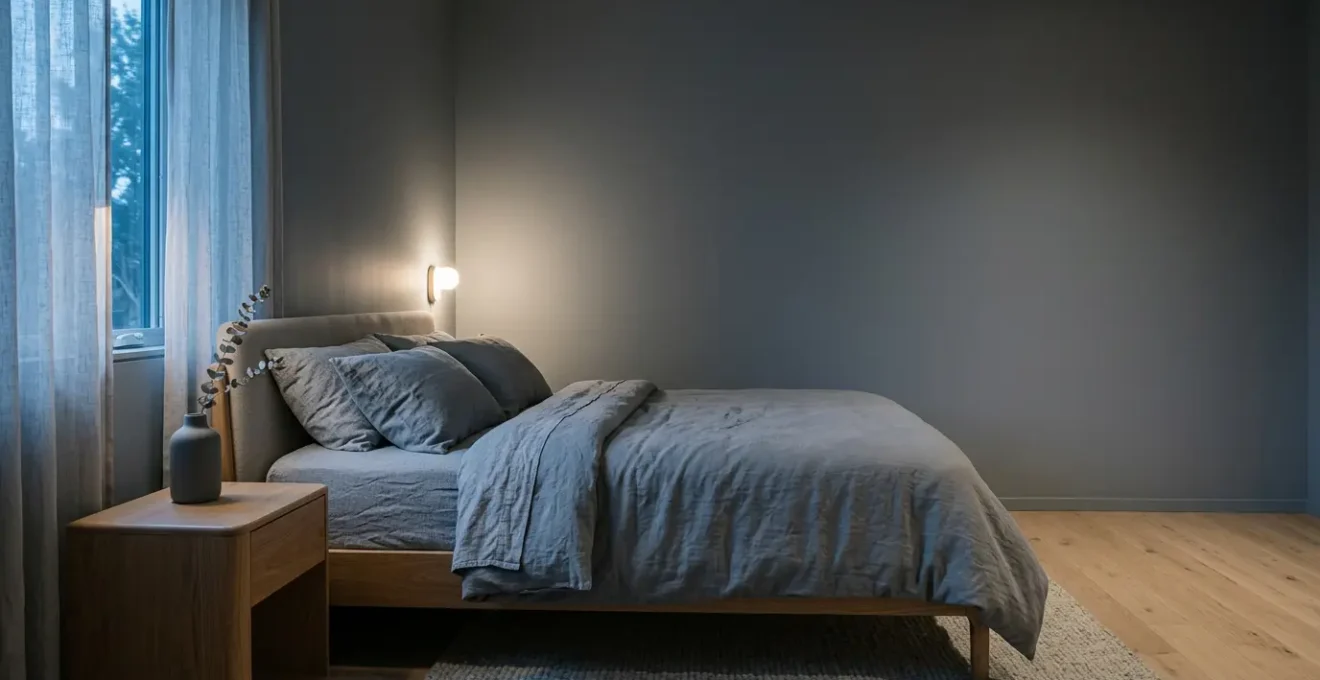
Contrary to popular belief, a good night’s sleep isn’t won by willpower; it’s engineered by design.
- Your bedroom’s temperature, light, and even air quality are active triggers that can keep your brain on high alert.
- The key is to systematically remove these triggers and replace them with cues that signal safety and rest to your nervous system.
Recommendation: Shift your focus from “trying to sleep” to designing an environment where sleep is the inevitable outcome.
For the light sleeper, the bedroom can feel less like a sanctuary and more like a minefield of potential disturbances. A distant siren, a sliver of light from the street, a room that’s just a degree too warm—each is a trigger that can reset the clock on falling asleep. You’ve likely tried the standard advice: avoid caffeine, stick to a schedule, meditate. Yet, you still find yourself lying awake, your mind racing as your environment conspires against you.
This isn’t a failure of discipline. It’s a failure of design. The common narrative around sleep hygiene places the burden entirely on your habits, overlooking the powerful, passive role your physical space plays. The truth is, your bedroom isn’t a neutral backdrop; it’s an active environmental system constantly sending signals to your brain. For a sensitive nervous system, generic tips are insufficient. You need an engineered approach.
What if the solution wasn’t to try harder to sleep, but to design a room where sleep becomes almost unavoidable? This guide moves beyond behavioral platitudes to focus on the structural and sensory engineering of your sleep space. We will deconstruct the environmental triggers—temperature, sound, light, air quality, and spatial arrangement—that keep your brain in a state of alertness. By understanding the science behind these triggers, you can systematically dismantle them and rebuild a bedroom that actively down-regulates your nervous system, guiding you into deep, restorative rest.
This article provides a blueprint for transforming your bedroom from a source of frustration into a high-performance sleep environment. We’ll explore each critical element step-by-step, providing the structural logic and sensory strategies needed to create a space that works for your sleep, not against it.
Summary: A Designer’s Blueprint for a Sleep-Inducing Bedroom
- Why You Should Sleep in a Room Colder Than You Think?
- How to Soundproof Your Sleep Space Against City Noise Cheaply?
- Blackout Curtains vs. Sleep Masks: Which Is More Effective for Deep Rest?
- The “Office in Bedroom” Mistake That Trains Your Brain to Stay Alert
- When to Ventilate: The CO2 Level That Disrupts Sleep Quality?
- How to Arrange Your Living Space to Subconsciously Boost Mood?
- The Environment Mistake That Keeps Your Nervous System on Alert
- Why You Wake Up Tired After 8 Hours: The REM Deficiency Problem?
Why You Should Sleep in a Room Colder Than You Think?
One of the most powerful and misunderstood environmental triggers for sleep is temperature. Your body is hardwired to initiate sleep with a slight drop in core temperature, a primal signal that it’s time to rest. Designing a bedroom that facilitates this natural thermoregulation is not a matter of comfort, but a biological necessity. The ideal sleep environment is often cooler than most people realize, typically between 60 and 67 degrees Fahrenheit (15-19°C). A room that is too warm forces your body to work harder to cool itself, actively disrupting the process of falling and staying asleep.
The impact of ambient temperature on sleep quality is not trivial. Rising global temperatures are already taking a toll; a 2025 study in Nature Communications found that for each 10°C increase in ambient temperature, total sleep duration decreased by nearly 10 minutes, with a significant reduction in deep sleep. This highlights the critical need to create a cool microclimate in the bedroom, independent of external conditions. The focus should be on materials and structure, not just the thermostat.
Achieving this optimal cool environment involves selecting materials that enhance breathability and dissipate heat. Think of your bedding as a high-performance system. Swap out heat-trapping synthetic fabrics like polyester for natural, breathable materials such as linen, cotton, or Tencel. These fabrics have superior moisture-wicking and thermoregulating properties, helping to maintain a stable, cool surface against your skin throughout the night. It’s about engineering a space that passively supports your body’s natural cooling process.
How to Soundproof Your Sleep Space Against City Noise Cheaply?
For the light sleeper, especially in an urban environment, sound is a constant threat to sleep integrity. The brain remains vigilant to auditory cues even during sleep, and sudden, irregular noises like traffic, sirens, or neighbors can trigger micro-arousals that fragment your rest. A recent 2024 study in Noise & Health confirmed that perceived noise pollution is significantly associated with poor sleep quality. The goal is not just to reduce volume, but to absorb and mask sound waves, creating a consistent and predictable auditory environment.
Soundproofing doesn’t have to involve expensive construction. It’s about strategically adding mass and absorbent materials to your room’s existing structure. Soft, porous surfaces are your greatest allies against intrusive noise. Hard surfaces like bare walls and floors reflect sound, creating echo and amplifying disturbances. By introducing textiles and other sound-dampening elements, you can transform your room’s acoustic profile from harsh and reflective to soft and absorptive. This approach is about layering textures to buffer your sanctuary from the outside world.
The most effective strategies focus on the main points of entry for sound: windows and walls. While blocking sound is one approach, masking it can be equally effective. Introducing a source of “white noise” or “pink noise” creates a constant, soothing auditory blanket. This consistent sound floor makes sudden, jarring noises less likely to startle you from sleep, as they are blended into the existing soundscape. A simple fan or a dedicated white noise machine can be a game-changer for masking the unpredictable sounds of city life.
Action Plan: Low-Cost Sound Absorption for Your Bedroom
- Install heavy velvet or multi-layer curtains to absorb sound waves and reduce external noise transmission.
- Place plush area rugs on floors to dampen sound reflection and reduce echo within the room.
- Position large bookcases filled with books against shared or external walls to act as effective sound barriers.
- Use fabric wall hangings or acoustic panels made from porous materials to absorb mid-to-high frequency noise.
- Employ white noise machines or fans to mask sudden, irregular urban sounds like sirens and traffic.
Blackout Curtains vs. Sleep Masks: Which Is More Effective for Deep Rest?
Light is the single most powerful environmental cue for regulating your body’s internal clock, or circadian rhythm. Your brain is exquisitely sensitive to light, and even minute amounts penetrating your eyelids during sleep can suppress the production of melatonin, the hormone essential for initiating and maintaining deep rest. Therefore, achieving absolute darkness is non-negotiable for a truly restorative sleep environment. The two primary tools for this are blackout curtains and sleep masks, each with distinct structural advantages and disadvantages.
Blackout curtains are a structural solution, designed to create a room-wide “light seal.” They are highly effective at blocking external light from streetlamps, passing cars, or early morning sun. However, their all-or-nothing approach can be a double-edged sword. While they create perfect darkness for sleeping, they also block the natural morning light that is crucial for signaling to your brain that it’s time to wake up. This can disrupt your circadian rhythm, making it harder to feel alert in the morning. They create a cave, which is excellent for sleep but can be disorienting upon waking.
A sleep mask, conversely, is a personal solution. It creates a seal directly over your eyes, blocking light at the source. Modern contoured masks are designed to allow for REM eye movement without putting pressure on the eyeballs, making them comfortable for all-night wear. The key advantage of a mask is its flexibility. It provides total darkness during the night but can be removed instantly upon waking, allowing immediate exposure to morning light to help reset your circadian clock. For the light sleeper, a high-quality, contoured sleep mask often offers a more a more targeted and biologically-aligned solution than room-darkening curtains.
The “Office in Bedroom” Mistake That Trains Your Brain to Stay Alert
Your brain is a powerful association machine. Over time, it learns to link specific environments with specific activities. When your bedroom is used exclusively for rest and intimacy, your brain develops a strong cognitive association: bed equals sleep. This conditioning becomes a powerful, passive trigger for sleep. Entering the room begins the process of mental and physiological down-regulation. However, the modern trend of multi-functional spaces has turned many bedrooms into offices, gyms, or dining rooms, severely weakening this crucial psychological link.
Working from your bed is perhaps the most damaging habit for this cognitive association. Research on multi-functional bedroom use shows that approximately 50% of people use their bed for activities other than sleep, including working and studying. When you answer emails, take calls, and solve problems in the same space where you are supposed to rest, you are actively training your brain to associate your bed with alertness, stress, and cognitive engagement. The environmental cue becomes confused: is this a place for rest or for productivity? For a light sleeper, this ambiguity is enough to keep the nervous system on high alert.
Keeping computers, TVs, and work materials out of the room will strengthen the mental association between your bedroom and sleep.
– Division of Sleep Medicine, Harvard Medical School
The solution is to structurally and visually reclaim your bedroom as a sanctuary for sleep. This requires creating a hard boundary. If you must have a workspace in the same room, use a physical divider like a screen or a bookshelf to create a distinct “work zone.” Critically, all work materials—laptops, notebooks, documents—must be put away and out of sight at the end of the day. The act of “closing the office” sends a clear signal to your brain that the workday is over and the time for rest has begun. Protecting this mental association is as important as any physical aspect of bedroom design.
When to Ventilate: The CO2 Level That Disrupts Sleep Quality?
While we focus on obvious triggers like light and sound, an invisible factor is often degrading your sleep quality: carbon dioxide (CO2). In a poorly ventilated, sealed bedroom, the CO2 you exhale throughout the night steadily accumulates. High concentrations of CO2 act as a respiratory stimulant, which can lead to more frequent arousals, restless sleep, and even headaches upon waking. This is not just a matter of “stale air”; it’s a measurable chemical change in your environment that directly impacts your physiology.
So, at what point does CO2 become a problem? Outdoor air typically has a CO2 level of around 400 parts per million (ppm). In a well-ventilated room, levels might stay below 800 ppm. However, in a sealed bedroom with one or two occupants, levels can easily climb to 2,000 ppm or even exceed 3,000 ppm over the course of a night. Research shows that sleep quality begins to degrade significantly once levels pass the 1,000 ppm mark. A field-intervention study comparing sleep in rooms with average CO2 levels of 2,585 ppm versus 660 ppm found a dramatic difference. Participants in the low-CO2 environment had objectively better sleep, felt more refreshed, and performed better on cognitive tests the next day.
The solution is strategic ventilation. This doesn’t necessarily mean leaving a window wide open all night, which can introduce noise and temperature fluctuations. The goal is to facilitate air exchange. Opening your bedroom door slightly can make a significant difference. A more structural approach involves “purging” the room’s air before bed by opening a window for 15-30 minutes. If you live in an area with poor outdoor air quality, a high-quality air purifier with a HEPA filter can help circulate and clean the air without introducing pollutants. Managing the invisible chemistry of your bedroom air is a critical, often overlooked, layer of sleep environment design.
How to Arrange Your Living Space to Subconsciously Boost Mood?
The physical arrangement of your bedroom has a profound, subconscious effect on your sense of safety and calm, which is a prerequisite for sleep. Environmental psychology offers powerful principles for arranging a space to reduce cognitive load and promote relaxation. One of the most important is the concept of “Prospect and Refuge.” This theory suggests that humans feel most secure in a space where they have a clear, unobstructed view of their surroundings (prospect) from a protected position (refuge). In a bedroom, this translates to placing your bed against a solid wall, preferably where you have a clear sightline to the door without being directly in front of it. This simple placement can significantly decrease subconscious feelings of vulnerability.
Visual clutter is another major source of environmental stress. A disorganized room filled with piles of clothes, stacks of books, and exposed items on shelves constantly signals “unfinished business” to your brain. As the Sleep Foundation’s research team notes, this visual noise can generate anxious feelings that make it harder to relax. The design solution is to create a sense of order and simplicity through strategic organization and furniture choice. Opt for closed storage solutions like dressers and wardrobes over open shelving. Strive for symmetrical arrangements, such as matching nightstands and lamps, which the brain processes with less effort, creating a subconscious sense of order and balance.
The flow and shape of the room also matter. Furniture should be arranged to create clear, intuitive pathways, eliminating trip hazards and a sense of being “blocked in.” This is especially important for a light sleeper who may get up during the night. Furthermore, incorporating rounded shapes—such as a circular rug, an arched headboard, or a round side table—can soften the space. Angular, sharp-edged furniture can be perceived as harsh or threatening, while curved lines are seen as more gentle and welcoming, contributing to a more serene atmosphere conducive to rest.
The Environment Mistake That Keeps Your Nervous System on Alert
Beyond the obvious disturbances, your bedroom can be filled with subtle sensory inputs that keep your nervous system in a low-grade state of “fight or flight.” This chronic alertness is the enemy of deep sleep. The primary mistake is creating an environment of high sensory complexity, which overloads your brain with information to process. A 2015 sleep study showed that people with cluttered bedrooms have a higher likelihood of sleep problems. The goal is to systematically simplify the sensory landscape of your room, creating a quiet, neutral space where your nervous system can finally stand down.
This process begins with a material and visual audit. Your environment should be dominated by a harmonious palette of natural, tactile materials like wood, wool, cotton, and linen. These materials are visually and texturally “softer” than hard, cold, synthetic materials like plastic and metal. Visually, you must eliminate complexity. This means avoiding busy, high-contrast patterns on wallpaper or bedding. Open shelving displaying numerous knick-knacks creates visual static; store these items out of sight. A single, calming piece of art is far better than a gallery wall.
The invisible environment is just as important. Electromagnetic fields (EMFs) from electronic devices can also be a source of environmental stress for sensitive individuals. Practice good EMF hygiene by creating distance between your bed and devices like your phone, router, and television. Consider switching to a battery-powered alarm clock and turning off your home’s Wi-Fi router at night. Finally, consider the “scent-scape.” Lingering fragrances from stimulating cleaning products or synthetic air fresheners can be agitating. The ideal sensory environment is neutral, allowing your nervous system to be free from any unnecessary processing, finally giving it permission to rest.
Key Takeaways
- Cool Down: Your body needs to drop its core temperature to sleep. Set your thermostat between 60-67°F (15-19°C) and use breathable, natural fabrics for bedding.
- Embrace Total Darkness: Even minimal light disrupts melatonin production. Use a combination of blackout curtains and a high-quality, contoured sleep mask for a complete light seal.
- Separate Work and Rest: Your bedroom must be a sanctuary for sleep only. Remove all work-related items to break the mental association that keeps your brain alert.
Why You Wake Up Tired After 8 Hours: The REM Deficiency Problem?
One of the most frustrating sleep-related experiences is getting a full eight hours in bed yet waking up feeling exhausted. This paradox is often a sign of poor sleep quality, not insufficient duration. It points to a disruption in your sleep architecture—specifically, a deficiency in the deep and REM (Rapid Eye Movement) stages of sleep. These are the most mentally and physically restorative phases, and your environment plays a starring role in either protecting or fragmenting them. You can be “asleep” for eight hours but if your environment is constantly causing micro-arousals, you’re not getting the restorative benefits.
Environmental factors are often the primary culprits. For instance, research on sleep architecture demonstrates that rooms above the optimal temperature selectively suppress REM sleep. Your body struggles to thermoregulate, and this effort fragments the delicate later stages of your sleep cycle. Similarly, low-level noise, inconsistent light, and high CO2 levels all act as disruptors that can pull you out of deep or REM sleep into a lighter stage, often without you ever consciously waking up. You spend enough time in bed, but the time is “junk sleep,” lacking in restorative power.
A comprehensive study that continuously monitored bedroom environments and sleep efficiency proved this conclusively. It found that sleep quality decreased in a dose-dependent manner with increasing levels of noise, temperature, and CO2. These factors didn’t necessarily wake participants fully but caused countless micro-arousals that fragmented their sleep cycles. This is the core of the problem: your bedroom environment, if not properly engineered, is actively preventing you from reaching and maintaining the very stages of sleep your brain and body need to repair and recharge. Waking up tired is a symptom of an environment that is failing to support your sleep architecture.
By systematically auditing and engineering your bedroom’s temperature, light, sound, air, and layout, you are not just hoping for better sleep—you are creating the conditions where restorative sleep is the natural, inevitable result. Start today by conducting a sensory audit of your own space to transform your results.